Short answer: Choose custom VOID security tape by defining where the opening evidence must appear, what package surface will receive the tape, and how the sample will be accepted. Compare full-transfer, partial-transfer, and non-transfer constructions on the actual carton, mailer, plastic, glass, or painted surface. Then confirm the hidden message, roll dimensions, print, variable data, quantity, packing, destination, and required documents before bulk production.
What is tamper-evident VOID security tape?
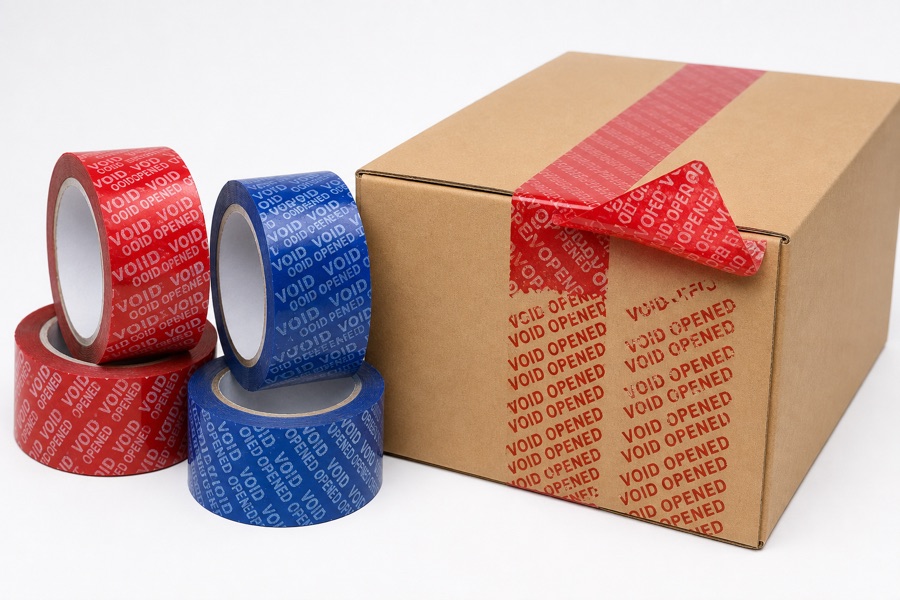
Tamper-evident VOID security tape is a single-use pressure-sensitive seal. When the tape is lifted, a VOID, OPENED, or approved custom message becomes visible on the package, within the tape, or on both, depending on the construction.
The visible change can help receiving teams identify possible opening during export sample handling, warranty returns, ecommerce delivery, distributor packing, document control, and warehouse chain-of-custody procedures. Although buyers sometimes search for "tamper-proof tape," the tape does not make a package impossible to open. It also does not prove who opened a package, prevent replacement of the entire package, or authenticate the product by itself. Anti-counterfeit verification requires additional identity and record controls.
Tamper-evident, tamper-resistant, and anti-counterfeit are different requirements
Define the required function before comparing security seal tape. These terms should not be treated as interchangeable.
| Requirement | What it is intended to do | What it does not prove by itself |
|---|---|---|
| Tamper-evident | Shows a visible change, residue, hidden message, or other evidence after the seal is disturbed. | Who opened the package, when it happened, or whether the contents are authentic. |
| Tamper-resistant | Makes unauthorized access more difficult through the package or closure design. | That access is impossible or that every opening attempt will be recorded. |
| Anti-counterfeit or authentication | Supports identity checking through controlled codes, records, secure labels, or other verification features. | That the package has remained unopened unless a separate tamper-evident feature is used. |
| Printed warning tape | Displays a logo, handling warning, or security message on the package. | A designed VOID reveal or transfer result unless the tape construction specifically includes it. |
How to choose full-, partial-, or non-transfer VOID residue tape
Use the following matrix as a sampling starting point, not as a guarantee. Adhesion and the reveal still need confirmation on the production surface.
| Buyer requirement | Construction to compare first | What to approve on the sample |
|---|---|---|
| A strong security message should remain on the package. | Full transfer | Message coverage, residue, surface damage, and whether the evidence remains easy to see after handling. |
| Evidence should be visible on both the removed tape and the package. | Partial transfer | How the message divides between both surfaces, readability, and resistance to attempted resealing. |
| The reusable surface should remain cleaner after removal. | Non-transfer | Reveal within the tape, residue limit, edge lifting, and whether the removed tape can be repositioned. |
| The substrate is recycled corrugated board, dusty, coated, or rough. | Compare surface-matched samples | Fiber tear, initial bond, delayed lifting, message clarity, and variation across multiple board samples. |
| The substrate is a PE or PP mailer, glass, plastic, or painted metal. | Compare adhesive and transfer constructions | Surface energy, coating compatibility, temperature, dwell time, residue, staining, and paint or print damage. |
Why the application surface changes the result
A tape that shows a clear VOID effect on a smooth test panel can behave differently on a recycled carton, coated paperboard, printed ink, dusty fiberboard, polyethylene mailer, polypropylene component, label coating, glass, or painted metal. The same material name is not enough: two corrugated boards can differ by mill, recycled content, coating, print, roughness, and storage history.
Provide a production sample whenever possible. If that is not practical, identify the exact substrate, coating, print area, recycled content, surface condition, expected temperature, application method, and time between application and inspection.
Use a repeatable sample acceptance record
A useful approval is more than "the VOID appeared." Record the conditions so a later roll or production lot can be compared with the accepted result.
| Record | What the buyer and supplier should document |
|---|---|
| Substrate identity | Carton or package material, supplier, coating, print, recycled content, surface side, and sample date. |
| Application condition | Surface cleaning, application pressure, roller or hand method, temperature, and humidity if relevant. |
| Dwell time | Time between application and removal, with the same intervals used for every sample being compared. |
| Removal method | Peel direction, angle, speed, and whether the test was performed at room, cold, or elevated temperature. |
| Tamper evidence | Reveal location, message clarity, repeat consistency, residue level, and visibility after normal handling. |
| Package effect | Fiber tear, coating lift, ink transfer, staining, deformation, or paint damage against the accepted limit. |
| Resealing check | Whether the removed tape can be repositioned and whether attempted resealing remains visible. |
| Approval evidence | Photos, sample code, roll or lot reference, artwork version, approver, date, and retained physical sample. |
How formal tape tests can support comparison
For projects that need measured adhesion criteria, the buyer and supplier can agree on a formal method, substrate, conditioning, and acceptance limit. ASTM D3330/D3330M covers peel adhesion methods for pressure-sensitive tape and notes that representative materials can be used to compare relative bond strength. ASTM D3654/D3654M covers shear adhesion under constant load and includes procedures for fiberboard or other agreed surfaces. ASTM D2860/D2860M specifically addresses pressure-sensitive tape adhesion to fiberboard under constant stress.
These references do not mean that every S-PACK SUPPLIES VOID tape is certified to a specific result. A test method, laboratory, specimen, units, conditioning, and pass/fail value must be agreed for the actual project.
How to specify custom printed VOID tape with serial numbers or QR codes
Selected tape constructions can combine a hidden VOID or OPENED message with surface printing such as a logo, warning text, serial number, barcode, QR code, or batch mark. Fixed artwork and variable data are different production requirements.
If every repeat needs a unique code, specify the sequence rules, data file, code size, reading distance, print direction, duplicate-control method, rejected-number handling, roll sequence, and packing record. A QR code or serial number supports traceability only when the buyer also manages the matching database, scan event, access rights, and exception process.
What affects MOQ and the quotation
The current S-PACK SUPPLIES product specification lists a custom-design MOQ of 200 rolls. The final MOQ, price, sampling plan, and production time depend on the transfer construction, PET film structure, adhesive, width, roll length, core, self-wound or release-liner format, base color, surface print, hidden message, variable data, packing, quantity, and destination.
Common project widths include 20, 25, 36, 48, and 50 mm. Common roll lengths include 25, 50, and 100 m. Available project colors can include red, blue, silver, white, clear, or a custom color; the current stock-color list is red, green, and blue. Every combination is subject to confirmation before quotation.
What evidence should a buyer request from a supplier?
- A written specification identifying the transfer type, hidden message, tape dimensions, roll format, print, and intended surface.
- An artwork proof showing message repeat, logo orientation, print direction, code area, and readable dimensions.
- A physical sample tested on the actual package, with the accepted reveal and residue photographed.
- A reference for width, length, core, winding direction, splice rule, packing, and labeling.
- A clear method for variable-data generation, duplicate control, sequence records, and rejected codes when applicable.
- The agreed tolerance, inspection method, sample retention, and action if a bulk lot differs from the approved sample.
- The requested compliance documents, with each document tied to the product, material, market, and order rather than a generic claim.
Tamper evidence is not automatic regulatory compliance
A general-purpose VOID tape should not be presented as automatically compliant for medicinal products, OTC drugs, food, forensic evidence, aviation, customs, or another controlled use. ISO 21976:2018 addresses tamper verification features for medicinal-product packaging. In the United States, 21 CFR 211.132 contains tamper-evident packaging requirements for certain OTC human drug products and includes labeling requirements.
If the application is regulated, the buyer must identify the destination market, product type, packaging level, applicable rule, required laboratory or validation protocol, labeling statement, document set, and party responsible for approval. Tape selection begins only after those requirements are known.
RFQ checklist for custom VOID security tape
- Purpose: opening evidence, warranty control, return control, authentication support, or chain of custody.
- Exact package type and surface, including coating, print, recycled board, PE, PP, glass, or painted finish.
- Required evidence location: package, tape, or both.
- Transfer type to compare: full, partial, or non-transfer.
- Hidden message: VOID, OPENED, or approved custom text.
- Tape width, roll length, core, winding direction, and hand or machine application.
- Base color, logo, warning text, print colors, and artwork file.
- Serial number, barcode, QR code, batch mark, sequence, and scan-record requirement.
- Application pressure, dwell time, service temperature, storage, and transport conditions.
- Trial quantity, bulk quantity, annual estimate, packing, and label requirements.
- Destination country, delivery term, and requested compliance documents.
- Physical package sample, acceptance criteria, approver, and retained reference sample.
Frequently asked questions
Is tamper-evident tape the same as tamper-resistant or anti-counterfeit packaging?
No. Tamper-evident VOID tape shows that a seal may have been lifted. Tamper-resistant packaging is designed to make access more difficult, while anti-counterfeit or authentication controls help verify identity. One tape does not provide all three functions by itself.
Which transfer type should I choose?
Start with the evidence location you need. Full transfer is considered when a strong message should remain on the package, partial transfer when evidence should appear on both the package and tape, and non-transfer when the surface should remain cleaner. Confirm the final choice on the actual package.
Will VOID tape work on recycled cartons, PE mailers, or PP plastic?
Not automatically. Recycled fibers, coatings, dust, roughness, low-surface-energy plastic, temperature, pressure, and dwell time can change adhesion and the reveal. Test the exact production material before bulk production.
How should a buyer approve a VOID tape sample?
Record the substrate, surface condition, application pressure, dwell time, temperature, removal method, reveal clarity, residue, surface damage, and attempted resealing result. Keep photos and the accepted physical sample as the bulk-production reference.
Can custom VOID tape include a logo, serial number, barcode, or QR code?
Selected constructions can include a logo, warning text, serial number, barcode, QR code, or batch mark after artwork and production review. A printed code supports traceability only when the buyer also controls the number sequence, records, scans, and exceptions.
What is the MOQ for custom VOID security tape?
The current S-PACK SUPPLIES product specification lists a custom-design MOQ of 200 rolls. Final MOQ depends on the transfer construction, dimensions, color, printing, variable data, roll format, packing, and approved sample.
Can this tape be used for regulated or medicinal packaging?
Only after application-specific review. A general VOID tape is not automatically compliant with medicinal-product, OTC-drug, food, evidence, or transport rules. The buyer must provide the destination-market requirement, test plan, labeling requirement, and documents needed before quotation and approval.
Technical references
- ASTM D3330/D3330M-04(2025): Peel Adhesion of Pressure-Sensitive Tape.
- ASTM D3654/D3654M-06(2024): Shear Adhesion of Pressure-Sensitive Tapes.
- ASTM D2860/D2860M-18(2024): Adhesion of Pressure-Sensitive Tape to Fiberboard.
- ISO 21976:2018: Tamper Verification Features for Medicinal Product Packaging.
- 21 CFR 211.132: Tamper-Evident Packaging Requirements for Certain OTC Human Drug Products.
Review the tamper-evident VOID security tape product specification and the broader packaging tape range. To compare constructions for your package, submit the surface, artwork, quantity, destination, and approval requirement through Custom Packaging Materials or contact S-PACK SUPPLIES.